Skip to content

Business hours

GST Consultants in Delhi - Pradeep Kumar

Monday
11am-7:30pm
Tuesday
11am-7:30pm
Wednesday
11am-7:30pm
Thursday
11am-7:30pm
Friday
11am-7:30pm
Saturday
11am-7:30pm
Sunday
12pm-6:30pm

You can anytime during the day with your query.

9891699557

Latest Posts & Updates

Fresh stories, announcements and offers about Chartered Accountant, Accountant, Tax Advisor, straight from our business.

New Income Tax Regime 2026: Tax Slabs & Section 87A

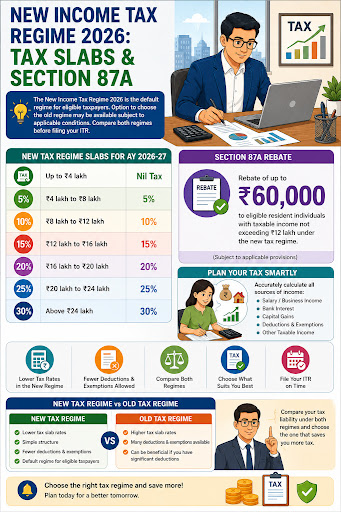
The New Income Tax Regime 2026 is an important topic for salaried individuals, professionals and taxpayers planning their income tax return for AY 2026-27. The new tax regime is the default regime for eligible taxpayers, although the option to choose the old regime may be available subject to applicable conditions. Taxpayers should compare both regimes before filing their ITR. New Tax Regime Slabs for AY 2026-27 ✅ Up to ₹4 lakh – Nil Tax ✅ ₹4 lakh to ₹8 lakh – 5% ✅ ₹8 lakh to ₹12 lakh – 10% ✅ ₹12 lakh to ₹16 lakh – 15% ✅ ₹16 lakh to ₹20 lakh – 20% ✅ ₹20 lakh to ₹24 lakh – 25% ✅ Above ₹24 lakh – 30% The Section 87A rebate under the new tax regime can provide a rebate of up to ₹60,000 to eligible resident individuals where taxable income does not exceed ₹12 lakh, subject to the applicable provisions. This makes tax planning and correct income calculation especially important. Before selecting a tax regime, taxpayers should calculate salary or business income, bank interest, capital gains, deductions, exemptions and other taxable income. The new regime generally offers lower slab rates but allows fewer deductions and exemptions compared with the old regime. Choosing the right regime depends on your individual financial situation. If you have significant eligible deductions or exemptions, compare the final tax liability under both options before filing your Income Tax Return.
New Income Tax Regime 2026: Tax Slabs & Section 87A post imageRead full post

ITR Due Date 2026: Who Must File by 31 August?

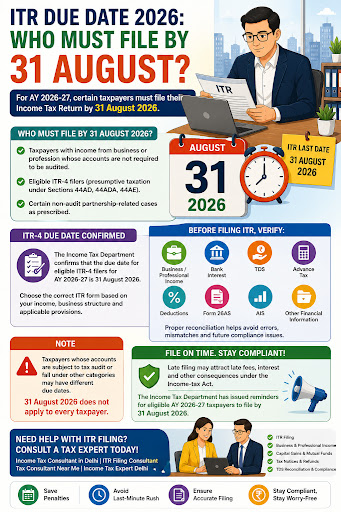
Are you searching for the ITR due date 2026, ITR last date 2026 or Income Tax Return filing deadline? For Assessment Year (AY) 2026-27, the due date for certain taxpayers with income from business or profession whose accounts are not required to be audited is 31 August 2026. This includes eligible non-audit business and professional taxpayers and certain non-audit partnership-related cases as prescribed. The Income Tax Department's guidance also confirms that the due date for eligible ITR-4 filers for AY 2026-27 is 31 August 2026. Taxpayers should select the correct ITR form according to their income, business structure and applicable taxation provisions. Before filing your Income Tax Return, verify business or professional income, bank interest, TDS, advance tax, deductions, Form 26AS, AIS and other relevant financial information. Proper reconciliation can help reduce errors, mismatches and future compliance issues. Taxpayers whose accounts are subject to tax audit or who fall under other categories may have different due dates. Therefore, do not assume that 31 August 2026 applies to every taxpayer. The applicable deadline depends on the taxpayer's category and legal requirements. File your ITR on time and avoid last-minute filing. Delayed filing may attract late fees, interest or other consequences under Income-tax Act. The Income Tax Dept has reminded eligible AY 2026-27 taxpayers to file by 31 Aug 2026.

ITR Due Date 2026: Who Must File by 31 August? post imageRead full post

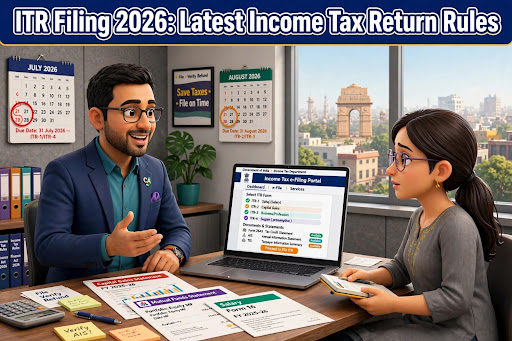
ITR Filing 2026: Latest Income Tax Return Rules

Stay compliant with latest ITR rules for AY 2026-27. For salaried individuals filing ITR-1 or ITR-2, the due date is 31 July 2026. For non-audit business or professional income cases, the deadline is 31 August 2026. New tax regime is default with revised slabs and Section 87A rebate as per conditions, while old regime with 80C, 80D, HRA deductions is available on opt-in. Compare both regimes to choose what saves more tax. Before filing, verify Form 26AS, AIS, TIS, Form 16 salary, bank interest, TDS, capital gains from shares and mutual funds, and advance tax payments. Selecting correct ITR form is key - ITR-1 for salary, ITR-2 for capital gains and foreign assets, ITR-3 for business income, ITR-4 for presumptive income under 44AD/44ADA. Check e-filing portal for income tax notices, refund status, TDS mismatch, AIS feedback and outstanding demands. Accurate disclosure avoids notices and speeds up refunds. Searching for ITR Consultant in Delhi, ITR Filing Consultant Delhi or Income Tax Consultant Near Me? Professional help ensures accurate filing, tax planning, mutual fund ITR, capital gains computation, notice reply and full compliance with Income Tax Rules 2026. Timely filing with proper records ensures smooth processing, avoids penalties and helps get faster refunds. File early, choose correct regime, verify AIS and 26AS, and stay fully compliant for AY 2026-27. Avoid penalties and ensure quick refund processing...

ITR Filing 2026: Latest Income Tax Return Rules post imageRead full post

Income Tax Updates 2026: ITR Filing, Tax Regime & Notices

Looking for the latest income tax updates 2026? Taxpayers should stay informed about ITR filing, due dates, new tax regime, income tax slabs, capital gains, TDS, refunds and income tax notices. For AY 26-27, taxpayers should check the applicable ITR due date based on their income and whether their accounts are subject to audit. Before filing an Income Tax Return, verify salary or business income, bank interest, TDS, Form 26AS, AIS, capital gains, mutual fund transactions, deductions and advance tax payments. Choosing the correct ITR form is also important. Business and professional taxpayers may need ITR-3 or ITR-4, depending on their circumstances and applicable taxation provisions. Taxpayers should regularly check the Income Tax e-Filing portal for income tax notices, refund status, TDS mismatches and outstanding tax demands. Proper reconciliation before filing can help reduce errors and future compliance issues. If you are searching for an Income Tax Consultant in Delhi, ITR Filing Consultant Delhi, Income Tax Consultant Near Me, ITR Filing Consultant Near Me, Tax Consultant Delhi or Income Tax Expert Delhi, professional assistance can help with ITR filing, capital gains, mutual fund taxation, TDS reconciliation, tax notices and overall income tax compliance. ITR Filing 2026, Income Tax Consultant Delhi, Income Tax Return Filing, ITR Filing Online, ITR Due Date 2026, New Tax Regime 2026, Income Tax Slabs 2026.

Income Tax Updates 2026: ITR Filing, Tax Regime & Notices post imageRead full post

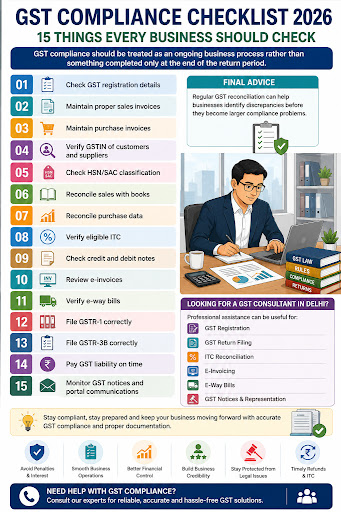
GST Compliance Checklist 2026: 15 Things Every Business Should Check

GST compliance should be treated as an ongoing business process rather than a task completed only at the end of the return period. Regular checking of invoices, books, Input Tax Credit (ITC), GST returns and tax payments can help businesses identify discrepancies at an early stage. GST Compliance Checklist ✅ Check GST registration details and ensure business information is updated. ✅ Maintain proper sales invoices with correct GST details. ✅ Keep complete purchase invoices and supporting records. ✅ Verify GSTIN details of customers and suppliers. ✅ Check the correct HSN/SAC classification and applicable GST rate. ✅ Reconcile sales records with books of accounts and GST returns. ✅ Reconcile purchase data with relevant GST records. ✅ Verify eligible Input Tax Credit before claiming ITC. ✅ Check credit notes and debit notes for proper reporting. ✅ Review e-invoices and invoice details wherever applicable. ✅ Verify e-way bills, delivery details and vehicle information. ✅ File GSTR-1 correctly with accurate outward supply details. ✅ File GSTR-3B correctly after reviewing tax liability and ITC. ✅ Pay GST liability within the applicable due dates. ✅ Regularly monitor GST notices and communications on the GST portal. Final Advice Regular GST reconcil. helps businesses detect errors before major issues. Timely return filing, proper records and regular GST data review are essential to maintain good compliance.

GST Compliance Checklist 2026: 15 Things Every Business Should Check post imageRead full post

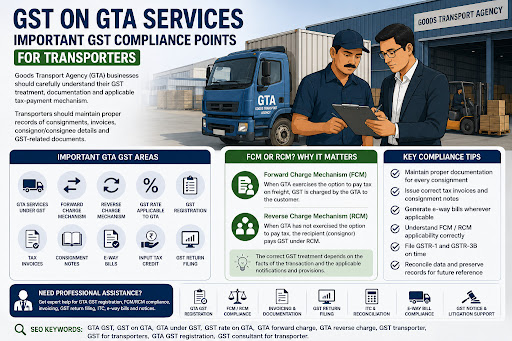
GST on GTA Services 2026: Important GST Compliance Guide for Transporters

Goods Transport Agency (GTA) services under GST require careful attention to the applicable tax treatment, documentation and compliance requirements. Transporters should understand whether GST is payable under the Forward Charge Mechanism (FCM) or Reverse Charge Mechanism (RCM) based on the nature of the transaction and applicable GST provisions. Maintaining proper records is essential for GTA businesses. Transporters should keep accurate details of consignments, invoices, consignors, consignees, consignment notes, GSTINs, freight charges and e-way bills wherever applicable. Important GTA GST Compliance Areas ✅ GTA services under GST ✅ Forward Charge Mechanism (FCM) ✅ Reverse Charge Mechanism (RCM) ✅ Applicable GST rate and tax liability ✅ GTA GST registration ✅ Tax invoices and consignment notes ✅ E-way bill compliance ✅ Input Tax Credit (ITC) ✅ GSTR-1 and GSTR-3B filing ✅ GST records and reconciliation FCM & RCM: Why It Matters The GST treatment of GTA services can depend on factors such as the recipient, nature of service, applicable option and relevant notifications. Therefore, transporters should not apply a GST rate or payment mechanism without checking the specific transaction and current GST provisions. Proper GTA GST compliance can help transporters avoid incorrect invoicing, tax short-payment, ITC issues, interest, penalties and GST notices.

GST on GTA Services 2026: Important GST Compliance Guide for Transporters post imageRead full post

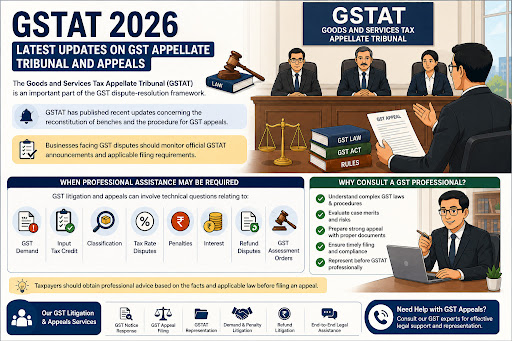
GSTAT 2026: Latest Updates on GST Appellate Tribunal & Appeals

The Goods and Services Tax Appellate Tribunal (GSTAT) is an important part of India’s GST dispute-resolution system. It provides taxpayers an appellate forum for challenging certain orders passed by GST authorities. Businesses facing GST disputes should carefully review the relevant order, applicable provisions, limitation period and filing requirements before proceeding with an appeal. GSTAT-related procedures and official announcements may change, so taxpayers should verify the latest information before filing. Common GST Disputes That May Lead to an Appeal GST appeals can involve several technical and financial issues, including: ✅ GST demand and assessment orders ✅ Input Tax Credit (ITC) disputes ✅ Classification of goods or services ✅ GST rate disputes ✅ Interest and penalty matters ✅ Refund-related disputes ✅ Registration cancellation or related orders ✅ Valuation and tax liability issues Why Professional Assistance Matters GST litigation and appellate proceedings can involve detailed documentation, legal provisions, calculations and strict procedural requirements. Before filing an appeal, taxpayers should review the GST order, demand details, supporting documents, relevant returns, invoices and reconciliation statements. A GST consultant can help assess matters, organize documents & prepare appeal per applicable law. For complex cases, consult a qualified GST lawyer or tax professional for guidance.

GSTAT 2026: Latest Updates on GST Appellate Tribunal & Appeals post imageRead full post

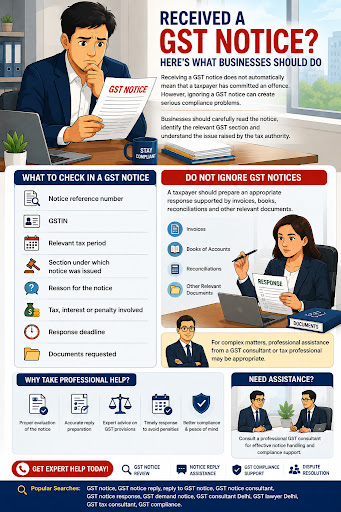
GST Notice 2026: What Businesses Should Do After Receiving a GST Notice

Receiving a GST notice does not automatically mean that a taxpayer has violated GST law. However, ignoring a notice or missing the prescribed response deadline can lead to further compliance issues, including demand, interest or penalty, depending on the facts of the case. Businesses should carefully read the notice and understand why it was issued, which tax period it covers and what information or documents are required before preparing a response. What to Check in a GST Notice Before replying, verify: ✅ Notice reference number and date ✅ GSTIN and taxpayer details ✅ Relevant financial/tax period ✅ Section or provision under which notice is issued ✅ Reason and issue raised by the department ✅ Tax, interest or penalty involved, if any ✅ Response or hearing deadline ✅ Documents and information requested How to Reply to a GST Notice A proper response should address each point raised in the notice and, wherever required, be supported by GST returns, invoices, books of accounts, payment records, reconciliations and other relevant documents. Avoid submitting incomplete or unsupported information. Businesses should also maintain a copy of the notice, reply, supporting documents and acknowledgement for future reference. Don't Ignore GST Notices Timely review and appropriate response can help businesses manage GST disputes and avoid unnecessary compliance problems. Please contact us feel free.

GST Notice 2026: What Businesses Should Do After Receiving a GST Notice post imageRead full post

GST Registration in India 2026: Complete Guide for Businesses

GST registration is an important tax compliance requirement for businesses that fall within the applicable provisions of the GST law. Whether you are a trader, manufacturer, service provider, transporter, freelancer, e-commerce seller, partnership firm or company, understanding your GST registration requirements is essential. The requirement for GST registration may depend on factors such as turnover, nature of business, type of supply, location and other applicable conditions. Businesses should check the latest GST rules and official notifications before applying. GST Registration Services A professional GST consultant can assist with: ✅ New GST registration ✅ GST amendment and profile updates ✅ Addition or removal of business details ✅ Additional place of business ✅ Authorized signatory changes ✅ GST cancellation ✅ GST restoration-related procedures ✅ Post-registration GST compliance ✅ GST return filing and reconciliation Documents Generally Required Depending on the constitution and circumstances of the business, documents may include PAN, Aadhaar/identity and address proof, photographs, business constitution documents, bank account details, proof of business premises and authorized signatory details. Exact requirements can vary, so applicants should verify the latest requirements on the GST portal before submission.

GST Registration in India 2026: Complete Guide for Businesses post imageRead full post

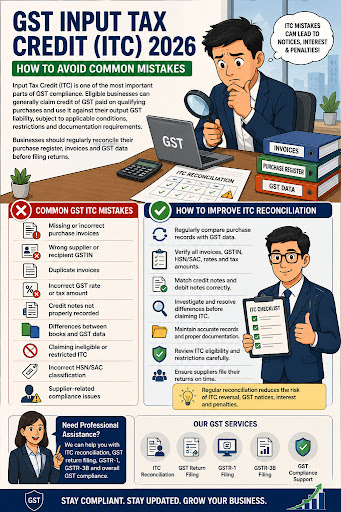
GST Input Tax Credit (ITC) 2026: How to Avoid Common Mistakes

Input Tax Credit (ITC) is one of the most important parts of GST compliance. Eligible businesses can generally claim credit of GST paid on qualifying purchases and use it against their output GST liability, subject to applicable conditions, restrictions and documentation requirements. However, simply recording a purchase invoice in the books does not automatically mean that ITC can be claimed. Businesses should regularly reconcile their purchase register, invoices and GST data before filing returns. Common GST ITC Mistakes Businesses should watch for: ✅ Missing or incorrect purchase invoices ✅ Wrong supplier or recipient GSTIN ✅ Duplicate invoices ✅ Incorrect GST rate or tax amount ✅ Credit notes not properly recorded ✅ Differences between books and GST data ✅ Claiming ineligible or restricted ITC ✅ Incorrect HSN/SAC classification ✅ Supplier-related compliance issues How to Improve ITC Reconciliation Regular reconciliation can help identify discrepancies before they become major compliance issues. Businesses should compare purchase records with the relevant GST data, verify invoices and investigate differences before claiming ITC. Maintaining accurate records and reviewing ITC regularly can help reduce the risk of ITC reversal, GST notices, interest and penalties. If you need professional assistance, we can help with ITC reconciliation, GST return filing, GSTR-1, GSTR-3B and overall GST compliance.

GST Input Tax Credit (ITC) 2026: How to Avoid Common Mistakes post imageRead full post

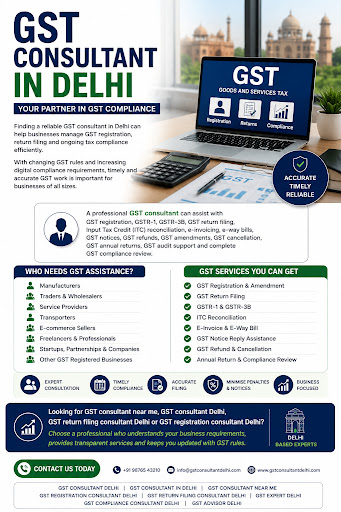
GST Registration, Returns, ITC & Compliance Services

Finding a reliable GST consultant in Delhi can help businesses manage GST registration, return filing and ongoing tax compliance efficiently. With changing GST rules and increasing digital compliance requirements, timely and accurate GST work is important for businesses of all sizes. A professional GST consultant can assist with GST registration, GSTR-1, GSTR-3B, GST return filing, Input Tax Credit (ITC) reconciliation, e-invoicing, e-way bills, GST notices, GST refunds, GST amendments, GST cancellation, GST annual returns, GST audit support and complete GST compliance review. Who Needs GST Assistance? GST support can benefit manufacturers, traders, service providers, transporters, e-commerce sellers, freelancers, startups, partnerships, companies and other GST-registered businesses. Professional assistance can help identify discrepancies, maintain proper records and reduce the risk of avoidable compliance issues. If you are searching online for GST consultant near me, GST consultant Delhi, GST consultant in Delhi, GST return filing consultant Delhi or GST registration consultant Delhi, choose a professional who understands your business requirements, provides transparent services and keeps you updated with applicable GST rules and notifications. GST Services You Can Get ✅ GST Reg. & Amend ✅ GST Return Filing ✅ GSTR-1 & GSTR-3B ✅ ITC Recon ✅ E-Invoice & E-Way Bill ✅ GST Notice Rep. Assistance

GST Registration, Returns, ITC & Compliance Services post imageRead full post

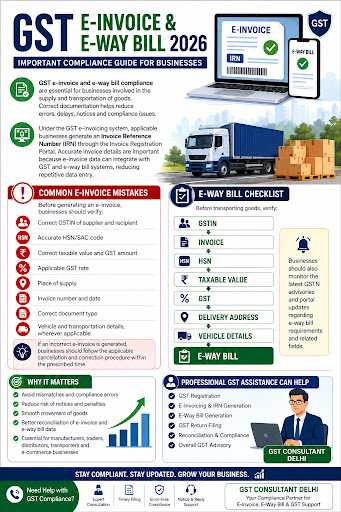
GST E-Invoice & E-Way Bill 2026: Important Compliance Guide

GST e-invoice and e-way bill compliance are essential for businesses involved in the supply and transportation of goods. Correct documentation helps reduce errors, delays, notices and compliance issues. Under the GST e-invoicing system, applicable businesses generate an Invoice Reference Number (IRN) through the Invoice Registration Portal. Accurate invoice details are important because e-invoice data can integrate with GST and e-way bill systems, reducing repetitive data entry. Common E-Invoice Mistakes Before generating an e-invoice, businesses should verify: ✅ Correct GSTIN of supplier and recipient ✅ Accurate HSN/SAC code ✅ Correct taxable value and GST amount ✅ Applicable GST rate ✅ Place of supply ✅ Invoice number and date ✅ Correct document type ✅ Vehicle and transportation details, wherever applicable If an incorrect e-invoice is generated, businesses should follow the applicable cancellation and correction procedure within the prescribed time. E-Way Bill Checklist Before transporting goods, verify: GSTIN → Invoice → HSN → Taxable Value → GST → Delivery Address → Vehicle Details → E-Way Bill Businesses should also monitor the latest GSTN advisories and portal updates regarding e-way bill requirements and related fields. Proper e-invoice and e-way bill reconciliation is especially important for manufacturers, traders, distributors, transporters and e-commerce businesses.

GST E-Invoice & E-Way Bill 2026: Important Compliance Guide post imageRead full post