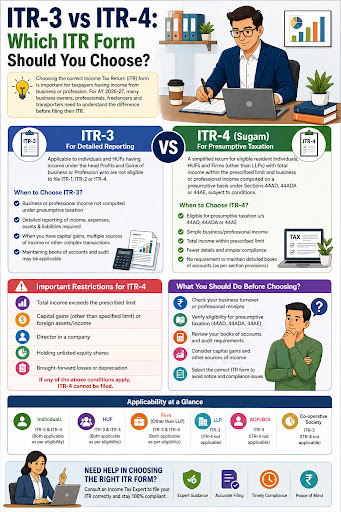
ITR-3 vs ITR-4: Which ITR Form Should You Choose?
Choosing the correct Income Tax Return (ITR) form is important for taxpayers having income from business or profession. For AY 2026-27, many business owners, professionals, freelancers and transporters need to understand the difference between ITR-3 and ITR-4 (Sugam) before filing their Income Tax Return.
ITR-3 is generally applicable to Individuals and HUFs having income under the head Profits and Gains of Business or Profession who are not eligible to file ITR-1, ITR-2 or ITR-4. It may be relevant where detailed reporting of business or professional income, assets, liabilities, capital gains or other applicable financial information is required.
ITR-4 (Sugam) is a simplified return available to eligible resident Individuals, HUFs and Firms other than LLPs with total income within the prescribed limit and business or professional income computed on a presumptive basis under Sections 44AD, 44ADA or 44AE, subject to applicable conditions.
Before selecting ITR-4, taxpayers should check restrictions relating to total income, capital gains, foreign assets or income, company directorship, unlisted shares and brought-forward losses. Not every business taxpayer is eligible for ITR-4.
Choosing the wrong ITR form may create filing and compliance issues. Before filing, verify your business turnover, professional receipts, books of accounts, presumptive taxation eligibility, capital gains and other income.